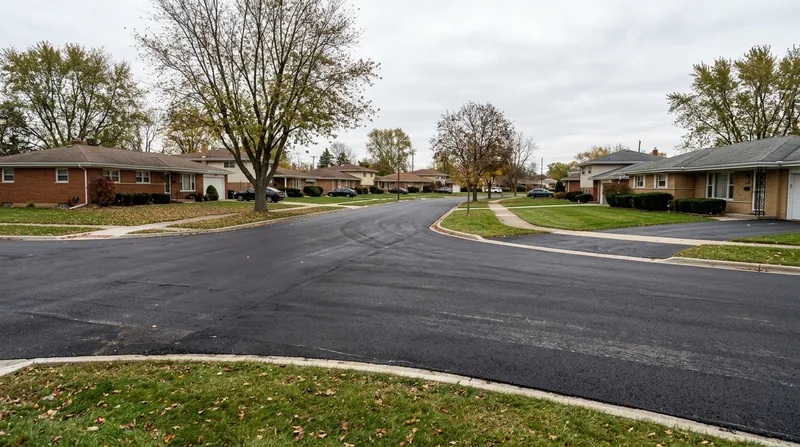




Private Road & HOA Paving in Gary demands a foundation built to withstand Lake Michigan's relentless freeze-thaw cycle. Gary's private roads and HOA communities sit on terrain that shifts dramatically block to block: sandy ridges near the Miller shoreline drain quickly but move under load, while the wet clay of the Calumet lake plain heaves with every winter freeze. The ground freezes deep here, down to 36 inches or more, and the lake's cold deepens that frost line in practice. Every spring, roads buckle. Every winter, the salt and freeze-thaw working together at the edges open alligator cracking and push asphalt apart. We build full-depth hot mix asphalt on a base engineered to that frost depth and that climate, with edge compaction and proper pitch to move water off ground that won't drain. The result is a private road or HOA street that holds for fifteen to twenty years without the constant patching that catches most contractors off guard.
Why Private Road & HOA Paving Fails in Gary's Climate
Gary's residential streets and private roads take a harder beating than most homeowners realize. The freeze-thaw cycle is relentless: water enters the asphalt and base during the thaw, refreezes at night, and expands. Repeat that fifty to eighty times a winter, and the base loses integrity. Add lake-effect snow and the road salt that comes with the plows, and you accelerate the failure at the edges where the base is weakest. Most patching stops the bleeding for a season, but if the base has gone soft, you're throwing money at the symptom.
- Freeze-thaw cycles in Lake County average fifty to eighty per winter, each one forcing water deeper into the base.
- Road salt and plowing accelerate edge failure where the asphalt meets the shoulder and the base is thinnest.
- Alligator cracking across thirty to forty percent of the surface means the base has failed and patching will not hold.
- A proper base built to the 36 inch frost line prevents the heave that opens cracks in the first place.
That's why a full-depth paving job on a private road or HOA street is not just cosmetic: it's the only way to reset the clock and avoid the spiral of patching that eats budgets.
Key info: Glen Park's ranch-block roads and the older streets near the mills in Gary's core both sit on clay that holds water. A private road in either zone must have a base carried down to the frost line and compacted in lifts, or the first hard winter will push the asphalt up in heaves and open cracks from underneath.
For a detailed look at how base preparation affects long-term durability, see our guide to gravel driveway installation and grading, which covers the foundation work that applies to any paved surface.
How We Build Private Roads & HOA Streets in Gary
A private road or HOA street paving job starts with the ground, not the asphalt. We measure the road, locate utilities through Indiana 811, and plan the base in lifts. The base is compacted aggregate, typically four to six inches on a clay plain or six to eight inches on sandier soil near the shore, all the way down to the 36 inch frost line. Then we set the crown and drainage, lay the hot mix in two lifts (a binder course and a wearing surface), and compact everything to density. The result is a road that sheds water, resists the freeze-thaw, and holds its shape under the traffic it will carry.
- We locate all utilities using Indiana 811 before any excavation, a legal requirement that protects your road and the lines beneath it.
- We build the base in compacted lifts, reaching down to the frost line and adjusting depth for the soil type at your site.
- We set the crown and pitch so water runs off toward the shoulders and does not pool on the road surface.
- We lay hot mix asphalt in two courses, binder and wearing surface, and compact each to proper density before it cools.
- We edge the road with compacted material so the asphalt does not crumble where traffic meets the shoulder.
The whole process takes planning and precision, which is why we provide written estimates with tonnage and thickness specs before we start.
Example: An HOA private road in Schererville on a half-mile loop through a master-planned community typically runs 24 to 32 feet wide. At six inches of base and three inches of hot mix, that's roughly 300 to 400 tons of material and a job that takes three to five days depending on weather and access. We measure, estimate, and schedule around the community's needs so residents have minimal disruption.
For more on how we handle large-scale projects, see parking lot paving and construction, which uses the same base-first methodology on a different surface type.
Private Road & HOA Paving Methods: Full-Depth vs. Overlay
| Approach | Description | Best for |
|---|---|---|
| Full-Depth Paving | Remove the old road down to the subgrade, rebuild the base to the frost line, and lay new hot mix asphalt in two courses. The gold standard for private roads and HOA streets in Gary. | Alligator cracking, soft or failed base, standing water, or a road that has settled or heaved. Resets the clock for fifteen to twenty years. |
| Mill & Overlay | Remove the top layer of old asphalt, mill it to a smooth surface, and lay a new wearing course on top. Faster and cheaper than full-depth, but only works if the base is still sound. | Surface wear, minor cracking, or a road that is still structurally solid but looks tired. Not suitable if the base has failed or if the road is settling. |
| Recycled Asphalt Base | Use milled reclaimed asphalt as the base material in a new road build. Cost-effective and reuses material, but requires good compaction and proper drainage design. | New private roads or HOA streets where the ground is stable and the budget is tight. Not suitable for areas with poor drainage or heavy traffic. |
| Tar & Chip | A surface of asphalt emulsion and stone chips, rolled and compacted. Looks rustic and costs less than hot mix, but wears faster and requires annual maintenance. | Low-traffic private roads, rural HOA streets, or temporary access roads. Not recommended for high-traffic areas or in Gary's harsh freeze-thaw climate. |
The choice between full-depth and overlay depends on what the base looks like. If the road is settling, heaving, or showing alligator cracking across more than thirty percent of the surface, the base has failed and an overlay will not hold. If the road is sound but the top layer is worn, an overlay buys you ten to twelve more years. We inspect the road, assess the base, and recommend the method that gives you the best value.
Private Road & HOA Paving Cost in Gary: What to Expect
A private road or HOA street paving job in Gary typically starts at $15,000 to $25,000 for a short residential loop or a single-block street, depending on length, width, base condition, and soil type. A longer road or a community with multiple streets can run $40,000 to $100,000 or more. The cost is driven by the length and width of the road, the depth of the base required (which depends on the frost line and soil type), the cost of trucking and compacting material, and whether you are doing a full-depth rebuild or an overlay.
Here's what affects the final number:
- Road length and width: a half-mile loop paved at 28 feet wide costs more than a quarter-mile street at 20 feet wide.
- Base condition: if the old base is intact and compacted, an overlay is cheaper; if it has failed, full-depth is the only answer.
- Soil type: sandy soil near the shore drains faster and may need less base depth; clay inland requires more compaction and deeper frost line work.
- Access and site conditions: tight turns, narrow shoulders, or utility conflicts add time and cost.
- Timing: spring and fall are peak season; winter work costs more and takes longer due to cold asphalt.
The best way to know your cost is to call us for a free estimate. We measure the road, assess the base, and provide a written quote with tonnage and thickness specs so you know exactly what you are paying for. Most HOA boards budget for full-depth paving every fifteen to twenty years and overlay or patching in between.
For a full pricing overview and examples across our service offerings, see our pricing page.
Private Road & HOA Paving Near Me: What Gary Homeowners and HOA Boards Should Know
Hiring a contractor for a private road or HOA street is a bigger decision than a driveway because the cost is higher and the road serves many households. Start by getting two or three written estimates from contractors with local experience and verifiable references. Ask each contractor to inspect the road in person, explain what they see in the base, and justify their recommendation (full-depth vs. overlay). A contractor who shows up with a clipboard, measures the road, and takes time to explain the work is more trustworthy than one who quotes over the phone.
Check whether your municipality or HOA requires permits for the paving work. Some villages in Lake County require a grading or paving permit; others do not. Your HOA may have architectural or design standards that govern the road surface, width, or finish. Verify these requirements with your local building department and your HOA before you sign a contract. Indiana law requires a utility locate through Indiana 811 before any excavation, so make sure the contractor you hire includes that in the scope.
Ask for references from other HOA communities or private roads the contractor has paved in Gary or the surrounding area. Call those references and ask how the road has held up, whether the contractor finished on time, and whether they would hire that contractor again. A contractor who has paved roads in your neighborhood or a similar one is more likely to understand the local soil and climate challenges.
Finally, be wary of unsolicited offers from door-to-door crews or contractors with out-of-state plates who claim they have leftover asphalt from a nearby job. That is the classic paving scam. A legitimate contractor has a local address, local phone number, and a verifiable track record. Gary Asphalt Paving has been in business since 2009 and serves Gary and the surrounding Lake County communities. Contact us for a free, no-obligation estimate on your private road or HOA street.
Private Road & HOA Paving in Gary: Pricing Guide
| Service | Price | Details |
|---|---|---|
| Private Road Paving (Short Loop) | Starting at $15,000 | Quarter to half-mile road at 20-24 feet wide, full-depth base and new hot mix, includes base compaction and frost line depth |
| HOA Street (Longer Community Road) | Starting at $40,000 | Half-mile to one-mile loop at 24-32 feet wide, full-depth rebuild with proper crown and drainage, includes edge compaction and two-course asphalt |
| Mill & Overlay (Existing Sound Road) | Starting at $12,000 | Milling and new wearing surface on a road with intact base, cost depends on length and width, faster than full-depth and suitable for moderate wear |
| Complex or Multi-Phase HOA Project | On estimate | Multiple streets, utilities, drainage work, or soil challenges require site inspection and engineering review before pricing |
| Utility Locate & Permits | Included | Indiana 811 locate and coordination with local building department are part of the scope, no separate charge |
| Free Estimate | Free | On-site measurement, base assessment, written quote with tonnage and thickness specs, 24-hour response at (219) 400-7205 |
Indicative pricing, the exact cost depends on square footage, finish, and site access. Free personalized estimate within 24h at (219) 400-7205.


