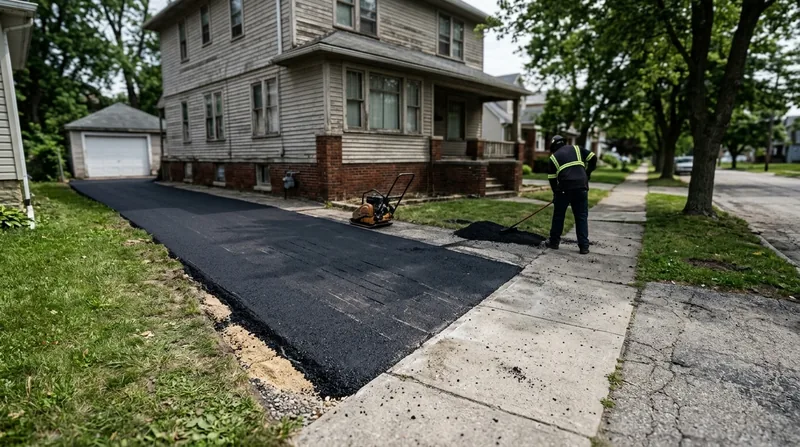




Driveway repair in Gary means understanding the ground beneath your pavement. Gary's driveways sit on three very different foundations: sandy ridges near Lake Michigan's shoreline in Miller that shift and settle, early-1900s neighborhoods with narrow city lots and tight drainage, and mid-century ranch blocks in Glen Park built on the Calumet lake plain where clay heaves with every freeze-thaw cycle. Winter brings lake-effect snow, constant freeze-thaw swings, and heavy road salt off municipal plows. All three work at driveway edges, opening alligator cracking where the base has softened. We cut out the failed asphalt, rebuild the base where it has failed, and patch with hot mix sized to the 36-inch frost depth that Lake County requires. That is how a patch holds in Gary.
Why Driveway Repair Matters in Gary's Climate and Soil
Gary's driveway failures follow the ground, not random wear. Edges crack first where sandy soil near Miller's shoreline shifts under the pavement, or where the low clay swales of the lake plain hold water and heave upward in winter. Road salt accelerates the breakdown, and the freeze-thaw cycle that dominates Lake County pushes failure deeper into the base each year. A small crack that you ignore in October becomes a pothole by March. Catching the damage early, cutting it out cleanly, and rebuilding the base to frost depth keeps the money in repair instead of watching it grow into a full replacement.
- Driveway edges in Gary crack first where sandy soil shifts or clay heaves under freeze-thaw stress.
- Road salt and winter moisture penetrate small cracks and enlarge them into potholes within a single season.
- Catching damage early and patching to the proper frost depth prevents the base from failing completely.
- Alligator cracking across a large area signals that the base has gone soft and a patch will not hold long-term.
Early repair stops the spread and saves money over time. Waiting for spring to act on winter damage is how a $500 patch becomes a $3,000 resurfacing.
Key info: Gary's lake-plain clay and sandy shoreline soils behave very differently. A driveway in Glen Park may need a deeper base rebuild than one in Miller, even though both sit in the same city. We assess the soil and frost conditions on site and build to what your ground requires.
For more detail on how soil and frost depth affect your repair, see our guide to gravel driveway installation and grading, which covers base preparation principles that apply to every driveway repair.
Indiana does not issue a state license for asphalt paving, but registration or licensing requirements are set locally by municipality. You should verify with your city or village that any contractor you hire meets the local standards required in your area. We work transparently and provide written estimates with tonnage and thickness specifications so you can compare proposals fairly.
How We Repair Driveways in Gary: The Process Step by Step
Driveway repair starts with a clear look at what has failed and why. We measure the damaged area, dig down to check the base, and determine whether the failure is surface only or whether the subgrade has softened. If the base is intact, a patch with proper compaction will hold. If the base has failed, we remove it, rebuild it to the frost depth, and install new asphalt on top. The difference between a quick patch and a longer-lasting repair hinges on that base inspection. We do not guess.
- We measure the damaged area and photograph the failure pattern to understand whether it is surface cracking or base failure.
- We saw-cut clean edges around the damage and remove all failed asphalt and any soft base material underneath.
- We inspect the remaining subgrade and rebuild the base if clay has softened or sand has washed out.
- We compact the new base to the 36-inch frost depth that Gary's climate requires.
- We install new hot mix asphalt, compact it to density, and finish the surface to match the surrounding pavement.
The whole job depends on that base work. Skip it, and the patch will fail again within two years. Do it right, and the repair will outlast the rest of the driveway.
Local example: A homeowner in Glen Park had alligator cracking along the east edge of a 20-by-10 driveway. The crack pattern told us the base had shifted under the clay. We removed the failed section, rebuilt the base to proper depth, and patched with new asphalt. The repair has held through three winters because the base was rebuilt, not just the surface sealed over.
For more on the decision between patching and full resurfacing, see asphalt resurfacing and overlay, where we explain when a patch is the right answer and when the driveway needs a larger repair.
Driveway Repair Methods and When to Use Each
| Repair Method | Description | Best for |
|---|---|---|
| Pothole Patching | Cut clean edges, remove failed base if present, compact new base to frost depth, install hot mix asphalt and finish flush with surrounding pavement. | Single or multiple potholes, localized edge failure, base failure under one section of the driveway. |
| Full-Depth Patching | Remove asphalt and base entirely down to the subgrade, rebuild base to 36-inch frost depth with proper compaction, install new asphalt with finish grade matching the original driveway. | Large sections of failed pavement, extensive alligator cracking, areas where the base has washed out or settled. |
| Cold Patch (Temporary) | Temporary asphalt material applied without heat to fill potholes and cracks for short-term damage control during winter or when the driveway is not ready for permanent repair. | Emergency repairs, temporary damage control, holding a pothole until spring when weather permits full-depth patching. |
| Saw-Cut Edge Patching | Saw-cut a straight line at the edge of the damage, remove failed asphalt cleanly, rebuild base if needed, install new asphalt and compact to match the existing surface. | Driveway edges that have cracked or separated from the main pavement, edge settlement from soil movement in Miller or Glen Park. |
The method we choose depends on how deep the failure goes and how much of the driveway is affected. A single pothole gets a pothole patch. Alligator cracking across thirty percent or more of the surface means the base is failing and patching will not hold long-term. In that case, resurfacing or overlay is the better investment.
Driveway Repair Cost in Gary: What to Expect
Driveway repair in Gary starts at around $450 for a small pothole or edge patch and scales with the size of the failed area, the condition of the base underneath, and whether the base needs to be rebuilt. A 20-by-10 driveway with one or two potholes and a solid base might run $600 to $1,200. If the base has failed and needs to be rebuilt to the 36-inch frost depth that Gary requires, the cost rises because we are doing more work below the surface. Soil conditions matter: sandy soil in Miller may drain and compact differently than clay in Glen Park, affecting the time and material needed.
- Small pothole or edge patch with a solid base runs $450 to $800, depending on location and size.
- Multiple potholes or alligator cracking across a small section costs $900 to $1,500 if the base is intact.
- Full-depth patching with base rebuild to frost depth costs $1,500 to $3,000 per damaged section, depending on size and soil conditions.
- Extensive damage across more than thirty percent of the driveway usually means resurfacing or replacement is a better value than multiple patches.
The best way to know what your repair will cost is to get a written estimate on site. We measure the damage, inspect the base, and give you a clear price with tonnage and thickness specifications so you understand exactly what you are paying for. For a full overview of pricing across all our services, see our pricing page.
Two or three estimates from different contractors will show you the range in your area and help you spot unrealistic pricing. Be wary of estimates that do not include base depth, compaction method, or asphalt thickness. Those details are what separate a repair that holds from one that fails again in two years.
Driveway Repair Near Me: What to Look for When Hiring a Contractor in Gary
Finding a good paving contractor in Gary means checking three things: whether they are fully insured, whether they provide a written estimate with tonnage and thickness specs, and whether they can give you references from local work. The strongest trust signal in this trade is a contractor with a local address and local plates, because the historic fraud in driveway paving is the itinerant door-to-door crew that claims to have leftover asphalt from a job nearby. That pitch is how people lose money. An honest contractor will measure your driveway, inspect the base, explain what has failed and why, and give you a written estimate before any work starts.
- Ask whether the contractor is fully insured and request a copy of the insurance certificate for your records.
- Get a written estimate that includes the size of the repair, the depth of the base, the asphalt thickness, and the total cost.
- Ask for references from three recent repairs in Gary or nearby, and call them to ask whether the work held up and whether they would hire the same contractor again.
- Check whether your municipality or HOA has requirements for driveway repair permits or architectural approval, and confirm that the contractor you hire will help you navigate that process.
- Verify that the contractor does not ask for a large cash deposit upfront or promise a price that seems too good to be true.
If you are in a master-planned community or an HOA, check your architectural standards before you get estimates. Some HOAs restrict driveway materials or require approval for repairs. Your contractor should be familiar with those rules, but the responsibility to verify is yours.
We are based in Gary, fully insured, and ready to give you a free estimate with no obligation. Call (219) 400-7205 or visit our contact page to schedule a site visit. We will measure your driveway, inspect the base, and explain exactly what repair is needed and what it will cost.
Driveway Repair in Gary: Pricing Guide
| Service | Price | Details |
|---|---|---|
| Small pothole or edge patch | Starting at $450 | One or two potholes with intact base, includes saw-cutting, removal, base inspection, and new asphalt installation |
| Multiple potholes or small alligator cracking | Starting at $900 | Several failed areas across the driveway, base condition assessed and rebuilt if needed, full-depth patching to frost depth |
| Full-depth patch with base rebuild | Starting at $1,500 | Large section of failed pavement, base removed and rebuilt to 36-inch frost depth required in Gary, new asphalt installed and compacted |
| Extensive damage (30% or more of surface) | On estimate | Alligator cracking or multiple failed areas suggest resurfacing or replacement may be better value than patching, requires site inspection |
| Free estimate | No obligation | We measure, inspect the base, assess soil conditions, and provide a written estimate with tonnage and thickness specifications within 24 hours |
Indicative pricing, the exact cost depends on square footage, finish, and site access. Free personalized estimate within 24h at (219) 400-7205.


