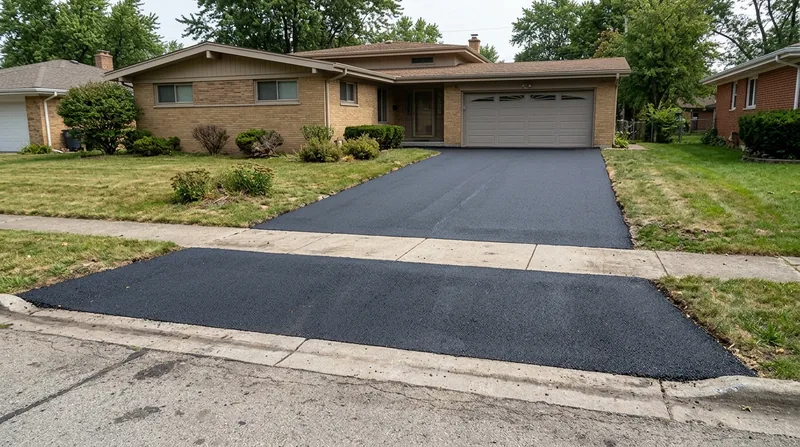




Asphalt Driveway Paving & Installation in Gary demands a foundation built to survive the freeze-thaw cycles and wet clay of the lake plain, plus the shifting sand near Lake Michigan's dunes. Gary's oldest neighborhoods in the mill districts and the mid-century ranches of Glen Park all rely on hot mix asphalt laid over a compacted aggregate base that reaches the 36 inch frost line, the depth the winter cold demands in this corner of Indiana. We build new driveways with that depth and pitch, sized to clear meltwater off flat lots and away from the house, because the real failure in Gary comes not from traffic but from water trapped under the surface and frost heave that breaks the edges and cracks the middle. A new driveway is a ten to fifteen year investment when it is built right, and that means understanding the ground beneath it and the weather that works against it every winter.
Why Asphalt Driveway Paving & Installation Matters in Gary's Climate and Terrain
Gary sits on two very different soils. The dune sand near Miller and the lakeshore drains fast but shifts under a driveway's edge when water moves through it, while the inland clay across Glen Park and the Calumet lake plain holds moisture and heaves with every freeze-thaw swing. Both soils demand a driveway built to the frost line and pitched to shed water, because the single biggest failure mode in Gary is not cracking from traffic, it is base failure and edge separation from water that gets trapped under the surface and expands when it freezes. Lake-effect snow and road salt from the plows accelerate this breakdown, opening alligator cracking in the top layer and widening cracks at the edges where the base has softened. A properly installed driveway puts that base at depth, compacts it in lifts, and slopes the finished surface away from the house so meltwater runs off and does not pool.
- We compact the aggregate base in 4 to 6 inch lifts, proof-rolling each one to verify density before the next lift goes down.
- We set the finished driveway at a pitch of 2 to 3 percent away from the house, so meltwater drains off and does not sit on the surface.
- We carry the base down to the 36 inch frost line on new installations, the depth the winter cold reaches in Lake County and the depth that stops frost heave.
- We edge-compact the sides of the driveway where the asphalt meets the yard, because edge separation is where water enters and the base begins to fail.
These steps add cost to the initial installation, but they prevent the soft base, the alligator cracking, and the edge failures that will cost you a resurfacing or a full replacement in five to seven years if the base is not right.
Key info: Gary's lake plain clay and dune sand both fail when water gets trapped under the driveway. A driveway built to the frost line with a proper pitch will shed that water and last fifteen years or more. One built shallow with flat grading will show alligator cracking in five to seven years, at which point the base is gone and patching will not hold.
For more on what goes wrong with a driveway and how to fix it, see our driveway repair page. If your driveway is already showing alligator cracking or soft spots, repair or resurfacing may still be an option; read about asphalt resurfacing and overlay here.
For information on permitting and municipal requirements in Gary, contact the City of Gary Building Department, which sets rules for driveway aprons, curb cuts, and impervious surface limits.
How We Install a New Asphalt Driveway in Gary: Step by Step
A new driveway starts with the ground. We begin by removing any existing pavement and grading the subgrade to the slope and depth the job requires. Then we bring in compacted aggregate base, crushed stone in 4 to 6 inch lifts, and we proof-roll each lift to confirm density before the next one goes down. Once the base is set to grade and depth, we call for a hot mix asphalt delivery and lay it in two lifts: a base course and a finish course. We compact each lift with a heavy roller while the asphalt is still hot, because proper compaction is what gives the driveway its strength and its life. The whole job, from site prep to finish rolling, takes two to three days for a typical residential driveway, depending on weather and site access.
- We remove the old driveway and grade the subgrade to proper elevation and slope.
- We deliver and compact the aggregate base in 4 to 6 inch lifts, proof-rolling each lift to verify density.
- We call for hot mix asphalt and lay it in two courses: base course and finish course, compacting each while hot.
- We edge-compact the sides to bind the asphalt to the yard and prevent water from entering at the edge.
- We pitch the finished surface at 2 to 3 percent away from the house so water drains and does not pool.
The entire process is built around the frost line and the freeze-thaw cycle that Gary experiences every winter, so the base is deep enough and the finish is pitched right.
Local example: A 20-foot by 10-foot driveway in Glen Park on flat clay ground would get a 36 inch base of compacted stone, brought in and rolled in six 6 inch lifts, then 2 inches of hot mix asphalt in two lifts, all sloped to shed water toward the street or the yard. Total time on site: two days. The homeowner can drive on it after 24 hours, though it will still be curing and will not reach full strength for several weeks.
See our driveway extensions and aprons page if you are also widening the driveway or adding a turnaround.
Methods and Approaches to Asphalt Driveway Installation
| Approach | Description | Best For |
|---|---|---|
| Full-Depth Replacement | Remove old asphalt and base, grade and compact new base to frost line, lay new hot mix asphalt in two lifts with edge compaction and proper pitch. | New driveways, or driveways with failed base, severe alligator cracking, or soft spots that patching will not fix. |
| Asphalt Overlay | Mill the top 1 to 2 inches of old asphalt, clean the surface, and lay new hot mix asphalt in two lifts over the existing base, assuming the base is still sound. | Driveways with surface wear but solid base, or driveways with minor cracking that is not yet alligator cracking. |
| Patching and Spot Repair | Cut out failed sections, clean and tack the edges, and fill with hot mix asphalt, compacting level with the surrounding surface. | Isolated potholes, alligator cracking in small areas, or edge separation affecting less than 20 percent of the driveway. |
| Milling and Full Removal | Remove the entire old driveway surface and base with a milling machine, haul the material off site or recycle it, and grade the subgrade for a new installation. | Driveways with extensive base failure, multiple repair jobs that have failed, or when the subgrade needs regrading or utilities need access. |
Asphalt Driveway Paving & Installation Cost in Gary: What to Expect
A new asphalt driveway in Gary starts at $6 per square foot as a baseline, but the real cost depends on the base depth, site access, and the condition of the ground you are building on. A 20 foot by 10 foot driveway, 200 square feet, would run roughly $1,200 to $1,500 for a full-depth replacement with proper base and compaction. A larger driveway in Glen Park, 24 feet by 20 feet (480 square feet), would run $2,900 to $3,600. If the ground is sandy and shifts, or if the site is tight and equipment access is limited, the cost goes up because base prep takes longer and compaction is more labor-intensive. If the base is already solid and you are overlaying, the cost drops because you are not removing and replacing the entire substructure.
The factors that move the price are clear: the depth of base required (36 inches on clay, sometimes less on sand if drainage is good), the size of the driveway, site access for equipment, and whether you are starting from bare ground or overlaying an existing surface. We provide written estimates with tonnage specifications, so you know exactly what is going into the ground and what you are paying for. Get two or three estimates from different contractors, because the difference between a shallow base and a frost-line base is not visible in the first year but it is worth thousands of dollars over the life of the driveway.
See our full pricing overview for more detail on what affects cost, and call us at (219) 400-7205 for a free, no-obligation estimate at your site.
Asphalt Driveway Paving & Installation Near Me: What Gary Homeowners Should Know When Hiring a Contractor
The paving trade has a well-earned reputation for door-to-door crews offering a deal that is too good to be true, and the reason is simple: the itinerant pitch, "we have leftover asphalt from a job nearby", is the classic setup for a shallow base, no written contract, and a large cash deposit that disappears when the job fails in two years. You protect yourself by verifying the contractor before you sign anything. Ask for a written estimate with tonnage and base depth specified, not just a square-foot price. Check that the contractor is fully insured and can provide a certificate of insurance. Ask for three references from jobs in Gary or nearby, and call them. Verify that the contractor understands local permitting: driveway aprons, curb cuts, and impervious surface limits are set by the City of Gary, and some jobs need a permit before work starts. If you live in an HOA community, check the architectural guidelines, some HOAs restrict driveway materials or extensions, and you need approval before breaking ground.
- Get a written estimate that specifies base depth in inches, tonnage of asphalt, and the number of lifts in the base and finish.
- Verify that the contractor carries full insurance and can provide a current certificate on request.
- Call three references from completed jobs in Gary or the surrounding area, and ask how long the driveway has held and whether any repairs have been needed.
- Check with the City of Gary if your driveway includes an apron, curb cut, or significant widening, because permits may be required.
- Review your HOA architectural guidelines if you live in a master-planned community, because material and extension rules vary by development.
- Never pay a large cash deposit upfront, and never sign a contract that does not specify the work to be done and the price in writing.
A contractor who is local, who shows up on time, who provides a detailed written estimate, and who can name three recent jobs in your neighborhood is the one you hire. We have been in business since 2009 and we are available for a free estimate at (219) 400-7205.
Asphalt Driveway Paving & Installation in Gary: Pricing Guide
| Service | Price | Details |
|---|---|---|
| New driveway, 200 sq ft (20x10), full-depth base to frost line | Starting at $1,200 | Includes site prep, compacted aggregate base to 36 inches, two-lift hot mix asphalt, edge compaction, and proper pitch for drainage |
| New driveway, 480 sq ft (24x20), full-depth base to frost line | Starting at $2,900 | Includes removal of old surface if present, compacted base to frost line in lifts, two-course asphalt, edge work, and pitch for water shedding |
| Asphalt overlay on existing driveway, 200 to 400 sq ft | Starting at $800 | Assumes existing base is sound; includes milling top layer, cleaning, tacking, and two-lift new asphalt if alligator cracking is light |
| Site access, tight quarters, or challenging terrain | On estimate | Sandy or wet subgrade, narrow lot, limited equipment access, or utilities near the surface require site visit to confirm labor and material cost |
| Travel to Gary and surrounding service areas | Included | No separate mileage charge or call-out fee; we cover Hammond, Merrillville, Schererville, Griffith, Highland, Hobart, East Chicago, and other Lake County towns |
| Free estimate | No charge | Call (219) 400-7205 for a site visit; we measure, assess base condition, and provide a written estimate within 24 hours, no obligation |
Indicative pricing, the exact cost depends on square footage, finish, and site access. Free personalized estimate within 24h at (219) 400-7205.


