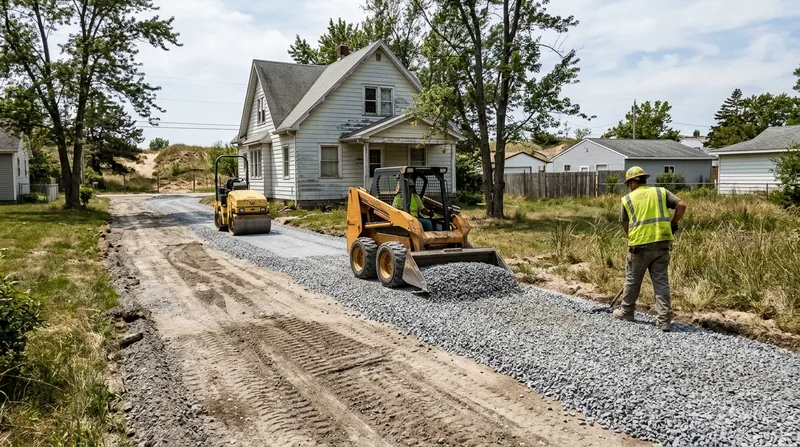




Gravel driveway installation and grading in Gary is essential work in a city where dune sand shifts under Miller homes near Lake Michigan and lake-plain clay heaves inland across the Calumet flats. Gary's freeze-thaw cycle, lake-effect snow, and constant freeze-thaw swings at the 36-inch frost line demand a properly graded and compacted gravel base that sheds water fast. When your driveway surface washboards, ruts, or puddles after rain, the base has often settled or the crown has flattened. We grade the surface, compact it to shed water, and add fresh stone sized and shaped to last through the next winter. Unlike asphalt, a gravel drive needs regrading every few years as the material settles and traffic pushes it around, but the cost is far lower and the repair is quick. If you're considering an upgrade to asphalt later, a well-graded gravel base gives you the foundation to build on.
Why Gravel Driveway Regrading Matters in Gary's Shifting Terrain
Gary sits on two very different landscapes. Near the shore in Miller and along the dunes, the ground is loose sand that moves with every heavy rain and freeze cycle. Inland across Glen Park and the Calumet plain, the clay holds water and heaves upward when it freezes, then settles as it thaws. Both conditions destroy a gravel driveway that was never graded properly in the first place or has gone years without maintenance. A driveway that holds standing water after rain will rot the base underneath, and ruts that funnel water toward your house invite erosion and foundation trouble. Proper grading tilts the surface away from the house and toward the street or drainage swale, so water runs off instead of pooling.
- We measure the slope and regrade the surface to shed water away from your home and foundation.
- We compact the base layer to prevent rutting and washboarding under car tires.
- We add fresh crushed stone or gravel sized to bind and lock in place without migrating.
- We shape the crown so the center sits higher than the edges, a proven method for fast drainage on the flat lake plain.
- We verify drainage patterns before and after, so the next heavy rain proves the work.
A well-graded gravel drive sheds water fast and holds its shape through the winter salt and freeze-thaw that tears up poorly drained bases.
Key info: In Glen Park and the low Calumet plain, clay bases that hold water are the primary enemy. We grade to a pitch of at least 2 to 3 percent so water runs off instead of pooling. A single poor grading job can cost you years of premature rutting and washboarding. See how driveway repair can address the damage, or start fresh with proper grading now.
Indiana law requires that any excavation work, including grading and base prep, follow Indiana 811 utility locates before we break ground. We call 811 on every job to mark gas, electric, water, and sewer lines so we don't hit them. Your city or county may also require a permit for driveway work, especially if you are extending the drive or changing the apron. We help you navigate local permitting, and you should verify requirements with your municipal building department.
How We Grade and Install a Gravel Driveway in Gary
A gravel driveway installation starts with a site visit to understand your terrain, drainage patterns, and soil conditions. We measure the slope from house to street, identify low spots that pool water, and plan the crown and pitch. If the old gravel is compacted and draining well, we may need only a regrading and fresh stone. If the base is rutted, washboarded, or sitting on clay that won't drain, we remove the failed material, regrade the subgrade, add a compacted base course, and lay new stone on top. The work is faster and cheaper than asphalt, and it buys you time to plan a paved surface later if that's your goal.
- We call 811 to locate all buried utilities before any excavation or grading begins.
- We remove failed or compacted gravel down to the subgrade and measure the existing slope.
- We regrade the subgrade to establish the proper pitch away from your house and toward drainage.
- We add a compacted base course, usually crushed limestone or recycled asphalt millings, to lock the surface in place.
- We lay fresh gravel or crushed stone in the correct size gradation, compacting as we go.
- We shape the final crown and verify that water sheds off the edges and does not pool in the center.
The entire process typically takes one to three days depending on the driveway length and the condition of the existing base.
Local example: A typical Glen Park ranch house with a 24-foot-wide, 40-foot-deep driveway sitting on clay-heavy lake-plain soil usually needs full regrading with a new compacted base and fresh stone. The job takes about two days, sheds water properly, and holds its shape for 3 to 5 years before light regrading is needed. A Miller home with a narrow driveway on sandy ground may need only regrading and fresh stone, a one-day job that costs less but still delivers the pitch and drainage that matter.
If you are planning to pave with asphalt later, a properly graded and compacted gravel base is the best foundation. Many homeowners use gravel as a temporary or long-term solution while they save for asphalt. See our guide to asphalt driveway paving and installation to understand the upgrade path.
| Approach | Description | Best for |
|---|---|---|
| Regrading and Fresh Stone | We remove surface rutting, reshape the crown, and add new gravel in the correct size without touching the subgrade. | Driveways with a sound base that have settled or lost crown after 2 to 4 years of use. |
| Full-Depth Grading and Base Replacement | We remove all old material, regrade the subgrade, add a compacted base course of crushed limestone or recycled asphalt, and lay fresh stone. | Driveways with rutting, washboarding, or clay subgrades that pool water and heave in winter. |
| Recycled Asphalt Base with Fresh Stone | We use recycled asphalt millings as the base layer because they compact and bind better than stone, then top with fresh gravel for a cleaner appearance. | Homeowners who want a longer-lasting gravel drive with minimal regrading needs over 4 to 6 years. |
| Grading for Future Asphalt Paving | We grade and compact a proper base course to the frost line depth, prepare for eventual asphalt installation, and use gravel as a temporary surface. | Homeowners planning to pave with asphalt within 1 to 3 years and wanting to defer the cost now. |
Gravel Driveway Installation and Grading Cost in Gary: What to Expect
Gravel driveway work is one of the most affordable driveway repairs available. A regrading and fresh stone job on a standard residential driveway in Gary typically starts at $950 to $1,400, depending on the length of the drive, the condition of the existing base, and the type of stone you choose. Full-depth regrading with a new compacted base course costs more, usually $1,500 to $2,800 for a typical two-car driveway, because we are removing old material and working the subgrade. The main factors that move the price are the square footage of the driveway, the depth of regrading needed, whether the base is clay or sandy, the haul distance for old material, and the type of stone you select. A long or very wide driveway, or one sitting on clay that requires significant base work, will cost more than a short, narrow drive on sandy ground.
We provide a written estimate with the square footage, the depth of work, the tonnage of stone, and the labor involved, so you know exactly what you are paying for before we start. We recommend getting two or three estimates from local contractors so you can compare scope, tonnage, and price. The cheapest estimate is often a red flag, because it usually means less stone, less compaction, or a shallower base. The best estimate is one that names the stone size, specifies the depth of compaction, and explains why the price is what it is.
Visit our pricing overview for detailed costs on all our services, and call us for a free estimate at (219) 400-7205. We respond within 24 hours, measure on site, and give you a firm price with no obligation to book.
What to Look for When Hiring a Gravel Driveway Contractor Near Me in Gary
Hiring the right contractor for gravel driveway work is as important as the work itself. A poorly graded drive will fail in a year, and a contractor who cuts corners on compaction or stone size will leave you with rutting and washboarding. When you call a contractor, ask for a written estimate that includes the square footage of the driveway, the depth of grading and base work, the type and tonnage of stone, and the labor cost. A real estimate takes time because the contractor must measure on site and understand your soil and drainage. Beware of door-to-door offers, verbal quotes with no written detail, or prices that seem too good to be true. Verify that any contractor carries full insurance, and ask for references from recent jobs in Gary or nearby towns like Hammond, Merrillville, or Griffith.
- Ask for a written estimate that names the stone size, specifies the compaction depth, and lists the tonnage of material.
- Verify that the contractor is fully insured and carries workers compensation and liability coverage.
- Check local references from homeowners in Gary or the surrounding area who had gravel work done in the last year.
- Confirm that the contractor calls 811 before any excavation or grading begins.
- Ask whether your municipality or HOA requires a permit for driveway grading or extension, and whether the contractor will help navigate the permitting process.
- Get a timeline in writing, so you know when the work will start and finish.
A local contractor who has been in business for years, provides written estimates, and can show you recent work in your neighborhood is the safest choice. We have served Gary and the surrounding Lake County area since 2009, and we stand behind every grading job with a commitment to proper slope, compaction, and drainage.
If you have questions about permits, HOA rules, or whether gravel is the right choice for your driveway, contact us for a free consultation. We can also discuss whether recycled asphalt millings or tar and chip might be better long-term options for your property.
Gravel Driveway Installation & Grading in Gary: Pricing Guide
| Service | Price | Details |
|---|---|---|
| Regrading and Fresh Stone | Starting at $950 | Reshape crown, add new gravel, no subgrade work. Typical for driveways with minor settlement after 2 to 4 years. |
| Full-Depth Regrading with Base Replacement | Starting at $1,500 | Remove old material, regrade subgrade, add compacted base and fresh stone. Needed for clay-heavy or rutted driveways. |
| Recycled Asphalt Base with Fresh Stone Overlay | Starting at $1,800 | Use RAP for longer-lasting base, top with fresh gravel. Reduces regrading frequency over 4 to 6 years. |
| Grading for Future Asphalt Conversion | Starting at $1,400 | Build proper compacted base to frost line, use gravel temporarily. Prepares foundation for later asphalt paving. |
| Travel and Site Visit | Included | No mileage fee or call-out charge in Gary and surrounding Lake County areas. |
| Free Written Estimate | No obligation | On-site measurement, tonnage specification, and firm pricing within 24 hours at (219) 400-7205. |
Indicative pricing, the exact cost depends on square footage, finish, and site access. Free personalized estimate within 24h at (219) 400-7205.


